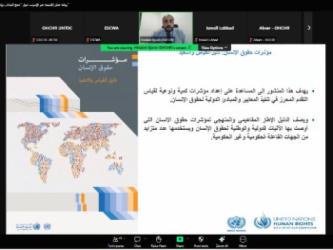

Human Rights Indicators Training

Human Rights Indicators Training
Programme Background:
The Office of the United Nations High Commissioner for Human Rights (OHCHR) has developed a framework of indicators aimed at promoting human rights, informing policymaking, assessing impact, and enhancing transparency. In this context, OHCHR dedicated years of research and consultations guided by the principles of universality, neutrality, objectivity, and cooperation to develop this tool, with the aim of strengthening the capacity of Member States to fulfil their human rights obligations.
This is based on the recognition that the use and analysis of indicators contribute to measuring progress achieved in the field of human rights, and that indicators are essential for the implementation of international human rights standards and obligations. OHCHR’s work seeks to encourage States and all stakeholders to adopt relevant, robust, and measurable indicators to assess progress (or regression) in the enjoyment of human rights by all.
Reliable data and indicators grounded in human rights standards constitute a core element of monitoring, evaluation, and reporting processes at both national and international levels. These tools have gained increasing importance in the context of monitoring the implementation of international human rights treaties, the Universal Periodic Review, as well as within the framework of the 2030 Agenda for Sustainable Development.
Such indicators also support international human rights mechanisms by providing accurate and rights-relevant information protected under human rights treaties, and by assisting these mechanisms in assessing States’ performance and progress in implementing recommendations addressed to them.
In this context, the programme focuses on strengthening the practical understanding of the conceptual framework of human rights indicators and supporting their integration into national systems for data collection and official statistics, while taking into account the principles of inclusivity, non-discrimination, accountability, and transparency.
The programme provides targeted participants with a range of key topics, including:
- The concept of human rights indicators
- The use of indicators within the international legal framework and the importance of data and indicators in the field of human rights
- Main sources of human rights indicators
- The role of indicators in monitoring and accountability
- The relationship between indicators and the Sustainable Development Goals
- The international framework for human rights indicators
- OHCHR human rights indicators
- Indicators used by treaty bodies and the Universal Periodic Review
- The use of indicators in national and international reporting, including treaty body reports and the Universal Periodic Review
- Types of indicators and data collection methodologies (data collection and analysis methodologies)
- Classification of human rights indicators (structural indicators, process indicators, outcome indicators), with practical examples
- Quantitative and qualitative data
Objective:
The training programme aims to enhance participants’ understanding of the concept of human rights indicators and their importance in monitoring and evaluation, through introducing the OHCHR methodology on indicators.
By the end of the training, participants will be able to:
- Define human rights indicators and explain the reasons for adopting them as a core monitoring tool
- Explain the international classification of indicators (structural, process, and outcome) with practical examples for each type
- Clarify how indicators are used in national and international reporting, including Universal Periodic Review and treaty body reports
- Discuss challenges facing the Arab region in data collection and the application of indicators, and propose practical solutions
- Strengthen coordination between government entities and national human rights institutions to develop effective monitoring and evaluation systems
Methodology:
The training course adopts an interactive approach to ensure effective participant engagement. It relies on the following methodologies:
- Introductory sessions including presentations delivered by experts in human rights and in data and indicator collection and classification, to explain key concepts and the international indicator framework
- Open discussions in the form of dialogue sessions, enabling participants to raise questions and discuss challenges faced in applying indicators at the national level
- Emphasis on exchanging experiences, sharing best practices, and highlighting successful experiences from Arab region countries, with the aim of strengthening mutual learning
Training materials will be provided at the beginning and throughout the course. Participants will receive a complete set of all training materials. Attendance for the full duration of the training is required in order to obtain the final certificate.
Speakers / Trainers:
The training team consists of a group of OHCHR experts with experience in data collection and the use of indicators, in addition to practical experience in delivering training programmes and providing technical support to government entities and national human rights institutions.
Partners:
- Government entities
- National human rights institutions in the Arab region
- National statistical offices
Target Audience:
- Statistics and data departments and entities concerned with monitoring and evaluating public policies in the field of human rights
- National human rights institutions in the Arab region, including monitoring and reporting teams